Part One
EARLIEST FAMILY RECORDS
Histories often begin with legend and the history of the
Dowman family is no exception. Thus the idea that the family was originally
Scottish is legend but supported by some facts.
It is generally accepted that DOW is an
anglicised version of COLM (pronounced Cullum) the
Gallic word for Dove
and that CLAN COLM are a branch of the
BUCHANAN CLAN.
The founder of the family is Alexander Dowman and
Alexander was a popular Scottish
name in these days. Furthermore Alexander's eldest
son Thomas married Mary daughter of
John Bruce obviously a Scot and most probably a
member of the House of Bruce.
 Another significant point is that Alexander possessed the Manor of
Lastingham in Blackamoor Edge near
Pickering Lythe, Co. York. A small river there is
called the Dove and probably took it's name from the family, just as at
a later date we have the Doman Woods named after the family who held the
house 'Willsfort' and lands there in Co. Cork around the
turn of the 19th century.
Another significant point is that Alexander possessed the Manor of
Lastingham in Blackamoor Edge near
Pickering Lythe, Co. York. A small river there is
called the Dove and probably took it's name from the family, just as at
a later date we have the Doman Woods named after the family who held the
house 'Willsfort' and lands there in Co. Cork around the
turn of the 19th century.
An interesting point here is that the
Scots descend from the DALLRIDANS who came
to Western Scotland around 800 A.D. from
Ulster. Their superior Celtic culture gradually
took over from the Picts and Irish became the
language of the Scottish Highlands.
In the year 1290 William
Dowman held lands at Millington, Co. York
and was a juror. This was in the reign of King Edward I and these
lands were still in the family in the reign of Henry VIII. He may well
be the father of Alexander who, as above-mentioned, held the
Manor of Lastingham in 1340.
That the family was well established by this time is born out
by the fact that Alexander married Mary, daughter
of Sir Gerard Salveyne, Sheriff of York and whose
ancestor fought with the Conqueror at Hastings
in 1066.
Although we know little about the early
Dowmans before the early part of the sixteenth century when the family
became possessed of the Manor of Pocklington, a glance at contemporary
history gives us a fair idea of their life style and problems.
In fact England in those times was going through a period of dramatic
change and ideas.
The Crusaders had opened up the Byzantine Empire, and the
East to trade and Venice was the great maritime
centre. All sorts of exotic goods were reaching Europe (silk and spices
etc.), and the fact that England was part of Europe
meant that the Upper Classes were absorbing new ideas and habits. Oxford
and Cambridge had been founded and of course the Crusaders had also
helped to widen people interests with tales of their adventures. Internally the country had been
peaceful and England enjoyed central Government and Parliament now
exerted considerable influence.
A very stabling influence as the rule of primogeniture and the
younger sons, when the time came, were sent off to seek their fortunes. Thus
England had an adventurous and roving spirit. The Upper Classes never
became a closed caste (like the French) and mingled and married into
merchant families. This left the eldest son with money and leisure to improve the comforts
of the Manor and develop Art craft and minstrelsy in the halls.
What was the Manor like when
Alexander Dowman lived? Obviously they varied a lot some being grander
than others. We can assume that Alexander with his connections was
reasonably affluent.
The Manor House consisted of a high roofed stone hall. In front
of it was a walled courtyard partly surrounded by buildings. The only entrance was through
the gateway of the courtyard, in some cases protected by a most. It would not withstand a siege
but would afford protection against a mob or troop of horse. The men who lived in these Manor
Houses had well-armed neighbours who could be violent.
The Lord and his villains shared the Manor and it's produce. The
lot of these villains was grim. They were bound for life but they did have some rights and
some Lords would have realised that well treated villains served then better. However, the
picture was to change somewhat with the enormous shortage of labour caused by the
Black Death and the towns people would not ask too many questions
when a deserting villains' labour was badly needed.
The Lord of the Manor was what we would describe nowadays as
Upper Middle Class, and in fact could be called the first of the English
country gentlemen.
In 1346 Edward III defeated the
French at Crecy. However
the event that most certainly imprinted itself on the minds of most people must have been the
Black Death 1348/9, which reduced the population by nearly one
third. Probably isolated places like Lastingham escaped the worst ravages
and indeed on can imagine that, soared stiff, they battened down the hatched and stayed close to
home. As the Manor was practically self-sufficient this would be possible.
The English language was now replacing French amongst the educated
classes. The speech of the East Midlands spoken in
London, Oxford and Cambridge
and employed by Chaucer, who enriched it with many
French words and by Wycliffe who introduced many
words of Latin.
This was then the world of Alexander.
The Manorial system brought England out of the Dark Ages.
It enabled man to subdue the forest and conquer the land. In an age of brute force it protected
the weak behind a shield of custom even if they were half slaves. It gave stability and peace
but with the terrible ravages of the Black Death the writing was on the wall.
Alexander's world was changing fast.
The population of about four million had been reduced to probably
two and a half million people and thus the market value of labour had virtually doubled. The
free labourer could demand higher wages while the unfree villain would look for better terms.
Without enough labour on the land and naturally a reduced demand for food, large areas were
reverting to wilderness. They was a way out of the dilemma and gradually the untilled land was
need for grazing sheep and this coincided with an increasing demand for wool, which in the future
was to become a great source of wealth for England.
POCKLINGTON
For the next hundred years or so the family continued in much the
same way of life as changes in the Northern part of the country developed at a more leisurely
pace.
Marriages were mostly with well to do local families and the fact that around
1470 John became possessed of the large Manor of
Pocklington shows a growing measure of prosperity. Notes on
Pocklington Church and School are contained in the York Archaeological
Journal Vol. XIV 1898 by Alex D.H. Leadman, P.S.A :
When the Domesday Book was made (1083-6) it was
a Royal Manor and under “Terre Regis”we find :
This shows how Normans had turned the fertile country into a desert.
To the Manor belongs the soke of these lands:
Meltoub Brune (Mumburtholme) one carucati Meltebi
(Meltonby) 8 carucates, Grinthorp 4 carucates. Mileton
(Millington) 13 carucutes; Brunebi (Burnby) 12 carucutes.
Alluures (Allerthorpe) 6 carucutes. Waplington
2 carucutes. Bernibi (Barneby Moor) 6 oxanges.
Thiusdale (Tivendale) 8 carucutes and Thorp (Thorpe)
3 carucutes.
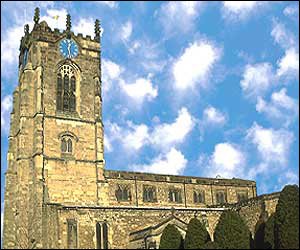
Pocklington Church has been a place of worship
for over 800 years.
The town has passed through so stirring times and probably families lived there over all these
centuries – a condition that an Irish Dowman may envy –.
It should be stated here that our name is variously spelt Dowman
or Dolman even Doleman an now in the U.S.A. Doman. Why this is we do not know.
One would incline to the view that the oldest form is Dowman and in fact all old documents
use this form. When I was a boy my grandfather told me that long ago members of the family held
the position of Keeper of the Kings Doves, but I have no idea where he got this information.
However sometime after the Reformation the Pocklington family seen
definitively to have adopted Dolman as the family name. Christopher,
a son of William of Pocklington, settled
in Hertfordshire and acquired the Manor of Newnham
and this branch of the family held on to the Dowman form.
|
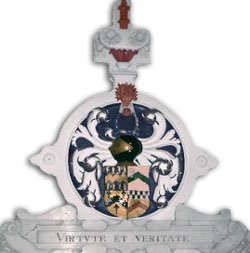
In Pocklington Church is
Dolman monument on which is the Dowman Arms :
Roughly this means on a blue shield 8 wheat sheaves 4 above.
Notte
|
|
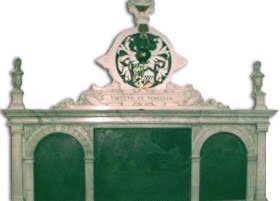 |
Beneath this are 3 compartments the centre having effigies of Thomas
Dolman and his wife and on either side are five sons and three daughters
kneeling-more of Thomas anon.
The monument is of black and white marble. A Latin inscription “ Hic
jacet Thomas Dolman “ and goes on the add the name of his wife
Elizabeth daughter of Peter Vavasor of
Spaldington and various other members of the family.
The whole is surmounted with the arms of the Dolman family quartered with those of the Vavasours.
|
While altering the floor of St. Nicholas Aisle
a stone slab, broken and decayed, was found five feet below the surface and on it were out the
letters J.D. The Church register begins in 1538 are contained
in 19 volumes. No gaps and very legible. Various Dowmans and Dolmans are
entered and again we note that the early ones are spelt Dowman.
John of Pocklington
had two sons William & Robert.
The eldest William had four sons:
- George said to have been Abbot of St. Mary's
York, whose handsome ruins bear witness to its one time beauty and grandeur.
- Archdeacon John
- Thomas whose family appears to have petered out on the male side
about 1654, and
- Christopher who settled in Hertfordshire and
is the ancestor of the Irish Dowmans and probably the Essex Clan.
Archdeacon John was a Churchman and Lawyer of some distinction and said
to have been Auditor of Causes under Cardinal Wolsey, that unlucky
prelate although a man of great energy and enormous mental capacity. It might be that it was
here he became interested in Education. John held in succession a
number of livings in the South of England and then was appointed
Prebend first in Sarum, then St. Paul's and
finally Lichfield Cathedral. In 1507 he was
appointed Archdeacon of Suffolk. In 1488 and
1494 he was made Bachelor of Canon and Doctor of Civil Law by
Cambridge University.
One comes across Archdeacon John in various places
and in one case he was sent to investigate, what might be described as the
“going on” of some monks who were alleged to have been
indulging in some “wine, women and song”.
At least the first two anyway. At this time the Church was very concerned about these abuses
and strenuous efforts were made to bring discipline back to the Religious Orders.
In medieval England education was in the hands
of the Church. The need for Choristers and Clerks able to recite the Latin Liturgy made it
necessary to educate boys in the science of Latin Grammar. In fact throughout
Europe the Church had been the real preserver of education in the Dark
Ages. However, the conflict between religious and secular learning existed, and the great pagan
writers Virgil and Cicero were accepted not
without qualms. As early as the thirteenth century schools were founded which were secular both
in purpose and government. To overcome legal difficulties a system of founding a guild was
introduced. These guilds were established in Churches or Cathedrals and were served by one of
more chaplains and were religious in interest but secular in so far as their members and officers
were all layman. Besides containing a grammar school they insured their members of sick pay, a decent
burial and prayers for the souls of the dead. They also engaged in the charitable duties in the parish.
It was in this context that a high officer of the Church like John Dowman
came to found his free Grammar School within a Guild. These schools gave free tuition in
Latin called the science of grammar. These schools cut across class barriers since they were
free and the son of a labourer (if he was bright) would share the same education
(and frequent corporal punishment) with the sone of a well to do father.
POCKLINGTON SCHOOL
The foundation and the re-foundation are well documented. The date of
the licence granted by letters patent under the Great Seal is 24th
May 1514. Land and new buildings for Guild and School were made available in
1522. In the deed dated 1st December 1525
granting of lands to St. John's College Cambridge to provide Scholarships
for boys from Pocklington School. In this Dr. Dowman
refers to ‘my school lately erected at Pocklington’.
The original patent still exists and sets forth in Latin the intended constitution of the Guild.
It was to be called the ‘Fraternity or Guild of the Name of Jesus and
the Blessed Virgin Mary and St. Nicholas’ founded in the Parish Church
of Pocklington in the country of York by
John Dowman Doctor of Laws.
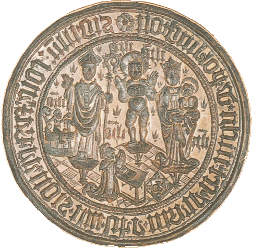
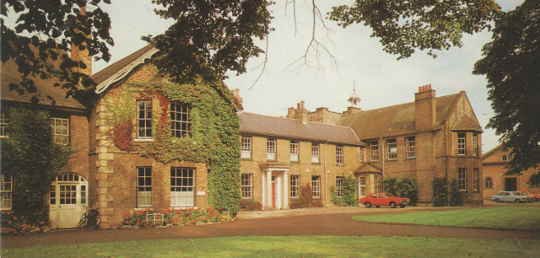
Photo coutesy of Pocklington School
Still in possession of the School is the Seal of the Guild, a rather
rare item and described by A.F. Leach in an article on the School in the
‘East Riding Antiquarian Societies Transactions’ 1897:
Below these figures is the excellent founder kneeling at a desk in prayer.
Note :
You can see here an excellent technical
study of Keith Walls on the seal of the guild (courtesy of Keith Walls)
St. John's College was founded in
1511 by Bishop Fisher acting as executor
to the Lady Margaret,
mother of Henri VII.
The executors lodged for a time with Dr. Dolman (memoir
of Margaret Courters of Richmond Derby CH Cooper Cambridge 1894 – p. 141 *)
possibly seeking his legal advice, and he thus was interested in the College at the time of its
foundation. Proof of this was his statute obliging Guild officers to consult the College about
the appointment of schoolmasters. In 1525 he made two notable benefactors
to the College founding nine sizarships and five scholarships for Pocklington
boys. In his will next year he left his books of Divinity to the College Library. As prebend of
St. Paul's he must have been interested in the foundation of the new St. Paul's School
by John Colet. (1467-1519, dean of St. Paul) He was evidently a man of
importance in these days of the renewed interest in education. He would appear to have been
in the seventies when he died in 1526. Good timing on his part as this
happened before Henry VIII's break with Rome.
It may be interesting here to speculate on Dr.
Dowman's thinking on the subject of education. As prebend of St.
Paul's he must have come under the influence of John Colet.
– Dean of St. Paul’s and founder of the famous St. Paul's
School. Colet was one of those who were responsible for new ideas in
learning. Briefly his aim was to give the young a real training instead of drill in pedagogic
formula. His example was gradually followed in other grammar schools so that the example he had
already set in Oxford was followed both there and at
Cambridge by his disciples. Bishop Fisher acting
as executor to the Lady Margaret responsible for the foundation of
St. John’s College (lodged, as we know have seen with Dr. Dowman)
put into Corpus Christi & St. John’s Colleges men of the new school.
Taking all this into account and the eventual close ties of the school with St.
John's it is reasonable to assume that Dr. Dowman not only founded
Pocklington School but was among the leaders of progressive education.
These men were sincere Catholics but the new style learning was to open men's minds to reform.
The sizarships are still called Dowman Sizarships.
Lands in Yorkshire and Derbyshire were made
to the College for the Scholarships and preference was given those who were his kin name.
The deed containing these items cemented the connection between the School and the College.
Boys have gone up from Pocklington to St. John's
as Dowman Scholars (since 1859 as Dolman
Exhibitioners) from that day to this.
Dr. Dowman's Will is so extensive and detailed that it is considered
of some historical importance and the few excerpts quoted here are taken from
the local Archaeological Journal. It was proved at the Prerogative Court of Canterbury.
It begin in Latin :
“In Dei nominee Amen …”
and the first bequest is to the Church of Saint Paul “a coope of
red cloth of golde and a vestment of the same” and also a sum of money. Also
“11 cushings of cloth of gold to lay before my Lord Byshopp
and the Deane whereof the two side is red cloth of golde and tother purpull
velvet.”
There is a bequest to St.Thomas's hospital.
“In my Archideaconry of Suffolk X Chalessis to be disposed by thanks of Roger
Kent, my Scribe for such churches as he shall think moost nede. I will bequethe all
my chief booke of Councille and Docteurs of the law … to the Universitie of
Cambridge … … all my books of Divinitie that be of great volumes to the
College of Saint John Cambridge … to my god children VIs VIIId … to the
pore persons in Newgate and Ludgate to be disposed in brede and drynke or
chese as the shell most node Vs … … Xis to the Redempcon of the prisoners that
lyeth onely for their fees in either of the said prisons (i.e debtor) … to Mr.
Dr. Wolman my wagyn and the harness for the horses … to the
Crafts of Haberdashers 11 great standing Salte wt a Cover pcell gyted (This
interest in the haberdashers is important as we shall see later)
… … to my brother X phofer Dowman 11 greate flat
bowlles with a cover a gowne, a jacket, a Doublet a horse sadyll and a bugille with horses
complete” Most of his furniture went to Christopher's
daughter e.g. “a trussinge bed wt the testor and ourtaine paand
of yellow and blewe saye” (silk, who would not like to have that bed now)
“a ffether bed, a bolster with 11 pillows, a pair of
blankette” (Elisabeth would be warn and snug) …
“ a table cloth, 11 pewter chargre, 6 pewter plattes, 6 dishes, 6 saucers a basin
and a ewer. A pottell pot, a quarte pot, a pynt pot, 11 pewter pttengers. A nutt paynted
with a cover silver and gilted, a caudron of brasse, a brasse pott, a brase panne,
a chasyng dishe of latton, 111 latton candlesticks, a brason morter with a pestell of
yron, a wter chafer of brases, a broche with 11 small Bache, a dripping pane of yron, a
frying penne, a pair of pothooke.” The other daughters fared less well and
get “a table cloth, a towel and 111 napkyns”.
One of the daughters, Margaret became a nun,
(a common practice in those days if a girl failed to get married), but we do not know that
Elisabeth married. The care shown in the Will regarding even quite bumble
household objects underlines the great value of such items in these days. Dr.
Dowman also showed concern of his punts (servents) they were “to
have at my buryal a gowne, and mete and drynke afterward by the space of a quarte of a
yems” He also left them “xx 3 a pece to pray for
me”. The rest of his will is devoted to his executors Robert
Russell and William Raschall.
REFOUNDATION OF POCKLINGTON SCHOOL
During the last twenty years the school appears to have flourished.
The school building had possibly two classrooms and up to 100 boys at a time are thought to have
attended. The College Register shows a full compliment of Dowman scholars.
Following the death of Henry VIII in 1547 and the ascension to the Throne of the boy king Edward
VI, the Protector Somerset put the reformation into full effect.
Among the first to suffer were the religious Guilds and their property was confiscated during the
Chartaries Act of 1547. Only a small part of the Guild was set aside for
their maintenance. These are now called Edward VI Schools, and many
disappeared while others survived by gifts from benefactors.
Pocklington School survived due to an odd
circumstance. The Guild was dissolved and its property confiscated. It appears that Dr.
Dowman never actually completed the transaction and Thomas Dowman,
J.P., and son of William Dowman, who was a cousin of Dr. John
Dowman claimed that as his heir, he Thomas owned the property in
his own right. His claim was based on the fact that William was co-ffee with
John and others of the property concerned and by surving then all he become
sole possessor. This is born out by the following : “Calendar of Final
Concords for Lincolnshire Edward I to Elisabeth “ (original in P.R.O.)
John Dowman, clerk, Christopher
Dowman, William Dowman with others querents. Mesuages and lands
in Candlesly, Delby, Partney, Langton and Sausthorpe. 14 Henry VIII Michaelsas (Bundle 25, File 156
N° 50) in case anyone wants to look it up. The date agrees with the land made available
to the school. This clearly show Dr. John, his brother Christopher and first cousin William (Thomas's father) all
in one deed as stated by Thomas. Thus as William's
heir he became the sole possessor. Thomas's plan was to petition Parliament
for the re-establishment of Pocklington School and to surrender the lands now
legally his for that purpose as originally intended by Dr. John. He was in
a strong position to achieve this as the choice was either to accept his terms or allow his to use
the property for his own benefit.
Being a lawyer of Gray's Inn doubtless as
barrister he had the necessary requirements to handle the business. Thus he petitioned Parliament
establishing the Free School of Pocklington in line with Dr.
Dowman's intended endowment subject to modification and additions as required. A copy
of this Act was passed in January 1551 and exists in a document of Letter
Patent dated July 1552. The Act embodying Thomas's
petition is long and detailed. It states that John Dowman for the zeal and
love which he had for his country and to the education and bringing up of youth in virtue and
co-learning gave to St. John's College lands with £15 a year to
support five scholars from the Grammar School freely erected by John Dowman
in Pocklington and among the deeds of composition between him and the
College was contained a clause that vacancies among the scholars should be supplies by the
nomination of a fraternity or Guild in Pocklington founded by Royal Licence.
The Chantries Act did not intend to destroy good and godly foundations made only for the
increase of learning is like to be clearly gone and taken away most contrary to the meaning and
good interest of the godly ordinance and foundation and yet St. John's
College still possessed the properties give for the purpose mentioned which thing is like to ensure
to the great displeasure and boss to the inhabitants of the Town of Pocklington
and all the country there unless it shall please your Majesty that the said godly ordinance maybe
recontinued and established.
The petitioner held in his own possession the school house and all the
lands and property purchased by John Dowman to maintain the school without
any use declared and no other device yet made for the more perfect continuance of the said Free
Grammar School. If the petitioner should die (where of he is most assured) they would be lost to
the school. Be it therefore e enacted … Here follows all the necessary rules and regulations
for the governing of the School, the appointment of Masters and Ushers and the requirement of
scholarships to St. John's College. As well as the local Vicar and
Churchwardens the College and the Archbishops of York were again given
overall authorithy.
Thomas can certainly be considered the Second
Founder. He was a generous and consciencous man and he lost no time in making over the property
to the school. In a enquiry under the directions of the Court of Chancery in 1698 a dispute over some of the lands at Thayburg led
to a jury finding that by a indenture dated 9th January 1553/4
Thomas gave to the Master and Usher Alexander Smith and their successors
for ever, all the measunges lands and tenements etc. to hold the same for ever. This document
explains how Thomas came to be the heir of the property. John
Dowman L.D.D. and William Dowman were jointly with other co-ferffees
seised in their demeure as of fee of lands tenecents in Thryburg and
William Dowman did survive the other cofecffees. William
was Thomas's father.
Thomas's tomb is in the Parish Church in the lady
Chapel and the inscription on the monument says that he was a Justice of the Peace, married to
Elizabeth Vavasour of Spalding and had 12 children
of whom 5 sons and 3 daughters survived his death in 1589. He and his
eldest son Robert were interested in the running of the school.
It took about 100 years for the Reformation to become accepted in
the Northern part of England and Thomas's family
were suspected of being subtle papists. The following is an extract from a letter of information
supplied by one of Queen Elisabeth's pursuivants to the Council and now
preserved in the «State Papers Office :»
Thomas's wife Elizabeth
was daughter of John and sister and sole of Peter
Vavasour
of Spalding. His brother Robert married Jane, daughter and co-heiress of John St. Tuistin
who died without issue. Sir Robert his eldest son married Eleanor daughter of Sir William Mallory of Studley. His second son Peter married Elisabeth, daughter of Richard Remington, D.D., and widow
of Rev. John Watson. A third son Marmaduke of
Millington married Ursula daughter of John Rudson and widow of Christopher Langley of
Millington. From Alexander onwards the family
tree shows the Dowmans marrying into well known local families and these
together with the ones mentioned above must have brought considerable wealth to the family.
However Thomas's association with the Leannox family
(strong supporters of Mary, Queen of Scots) and his
apparent almost open association with well known papists carried enormous risks and it is not
surprising that in 1610 James I granted portions
of his estates to David Drunmond as punishment for nonconformity (Vide State
Papers). Brother Marmaduke was even more unlucky being stain at Marston Moor fighting for the King in 1645. In
1652 his name was inserted in the bill of sale of lands forfeited to the
Commonwealth for treason (Vide Journal of the House of Commons).
Marmaduke's son Marmaduke
was in arms against the parliament and in 1652 an Act was passed confiscating
his estates for treason. Two years later he died. Going back to Sir Robert
his grandson also Robert described as a devoted adherent to the Royal cause;
in 1664 he and his wife were indicted for not coming to church … a
serious offence then. His other another Robert made history by being
implicated in the infamous ‘Papish Plot’.
In 1679 this Robert Dolman was indicted for high
treason by the promoters of the pretended "Papish plot", on a charge
of plotting with Sir Robert Gascoigne of Barnbow,
John Middleton, of Stockeld Hall, Lady
Tempest, Sir Francis Hungate, Sir Miles
Stapleton of Carlton, and other papists of quality, to kill king
Charles II and his brother, to promote the Roman Catholic Religion, and to
establish a nunnery at Dolbank, near Ripley. This was
the work of the notorious Titus Oats. It was a very obvious ‘frame
up’ and they were all, however acquitted upon the evidence of Sir Thomas
Yarborough and his wife. (Vide
Surtees Society, vol. II) The sad outcome of this episode was that it got maximum publicity and
aroused a popular fury of persecution of Catholics.
Before leaving Thomas and the Dolman family, now obviously very much reduced from their former affluence,
I would like to mention a little sidelight on Thomas. In 1955/56 I was corresponding with Mr. Fudge, editor of the
‘Genealogical Quarterly’ and, in a letter dated 27th Jan., 1956
he sent me the following information :
Well as it happened it did not prove impossible to track that item
down. With some persistence and a lot of luck over a period of two years I did just that and it
is now in my possession. It is in excellent condition and has attached the great seal. This is about
the size of the palm of my hand and shows Queen Elizabeth I seated on the
throne with the Orb and on the reverse side the Royal Arms. It seems most probable that it refers
to our Thomas. The Thomas in the deed being a
coroner would be a solicitor. Furthermore the fact that Thomas's daughter
Bridget married George Middleton of Newton, Co. Durham denotes a connection with that part
of the world. Also it would be most unlikely that we should be unaware of another Thomas at that precise date. I feel that if Pocklington
School felt an interest in this historical document it really should be in the possession of the school;
(Since writing above my niece Lynn Alison have, on my behalf, presented it to
the School xxx is to be framed).
Part Two
CHRISTOPHER MOVES SOUTH
Christopher, son of William
and brother of Dr. John removed from Yorkshire down to the
village of Newnham near Baldock, Hertfordshire, and only a few miles south of the border with Cambridgeshire. We know very little about Christopher except
that he married Elizabeth, daughter of Thomas Mowswiorth.
He maintained a close relationship with his brother Dr. John and as we have seen,
is mentioned in his Will. He may have moved southwards for reasons of health. He died in 1539, 13 years after his brother John and he probably
passed his 70th birthday.
He named his elder son John after his brother.
He died in 1558. His wife was Jane, daughter of
Henry Sapcotts of Lincoln. One sister Margaret was a nun. John's heir was James, born 1598 and he married Joan,
daughter and heiress of Henry Gowlshull of Bedford in
Helderness in Yorkshire. He had two brothers William
who held the Manor of Caldecote (only a few miles from Newhenam) and another
brother Christopher who we think died young. William
is a mystery. The Manor was in the family from 1557 to 1593/4. I have searched far and wide for William but have
been unable to trace him, which is odd as the rest of the family is accounted for. The reason for
this interest in Christopher and his family is because it is from this
branch of the family that the Irish Dowmans descend. When I was a boy my
grandfather Charles (b. 1843) told me that the family
come originally from Pocklington and I have a letter dated 1866 from Marmaduke Dolman to Capt.
Dowman (b. 1810) giving his information about the Dowman Arms. From the tone of the letter it is obvious that Marmaduke regarded Capt. John as a Dolman/Dowman connection. Here is the letter quoted in full :
|
August 21 1866
|
Souldern House Banbury. |
My dear Sir,
I am very much obliged to you for your letter
and the secutehone. I shall be very leased to see the painting on wood
when it is ready. I send you six varieties of the arms as born by my
own family, originally spelt Dowman or Dolman indifferently. The first
one borne by Archdeacon Dowman or Dolman in the reign of Henry 7th
and Henry 8th appears to have been the original one. The others
were variations. The second one is that borne by the Dolmans of Pocklington,
which family I represent. The last was borne by a Dowman of Yorkshire about
the time of Queen Elisabeth I and appears similar to the one you bear. The
Dolmans of Newnham and Newbury were eminent people in their day but have
long been extinct. However, you will see some mention of them in the paper
I gave you.
Yours faithfully,
Marmaduke Dolman.
|
It is a pity that we do not have that paper referred to in the
letter although I expect that we know a good deal more.
The point that interests us is the information
accompanying the letter and referring to the arms as borne by James
Dolman of Bedford in Holderness. This is obviously James of Newnham because, as mentioned above, he
married Joan, daughter and heiress of Henry
Gowlshull of Bedford in Holderness. The arms are:
‘Azure on a fess engrailed between 3 garbs or on this 3 birds
close on field beaked and membered gules.’ These are same arms as assigned
to the Newnham family (Vide ‘Visitation of Herts. & Clutterbuck
(or Cluckbuck) History Harlem (probably Harleian) Mss 6769’
Marmaduke has James
dying November 10th 1607. In fact this is the date of the
death of James's wife Joan. A brass effigy
of her and her children is still in Newnham Parish Church whis the
following inscription :
It would seen that James
having inherited property in Beford left Newnham
and went to live there. His son Edward lived in
Swinhope, Lincs.
The point to note here is that the arms as borne by
Irish Dowmans are the same as above, except that the fesse is dancette
instead of engrailed. This would be in order because they would be entitled to a variant of
the Arms as borne by James, his son Edward would
be the only person legally entitled to the first version.
The painting on wood referred to in
Marmaduke's letter is in my possession and was given to my by my cousin
Ethel a grand-daughter of Capt. John Dowman
to whom the letter is addressed, and the arms are as described in the letter. For the benefit
of those not familiar with the terminology of heraldry this is what the look like:
On an azure blue shield are three golden wheat sheaves, 2 above and
one below a band across the front of the shield. On this band are 3 birds with red beaks
and red legs i.e. choughs, the band look like this  which is the only difference from the original Newnham arms where the band is in the
form of zigzag.
which is the only difference from the original Newnham arms where the band is in the
form of zigzag. 
Now all this while interesting enough is important in that it shows
a link between Newhenham and Ireland.
This brings us to George Dowman whom we
believe to be the first of the Cork Dowmans. According to the Lismore
Papershe is given as renting a house and garden in Bandon co.
Cork in 1627. In 1628
the parish records of St. Bride's Church, Fleet Street,
London gives this information in the parish register under
‘marriages’ ‘George Dowman dwelling co. Cork
aged 21, his father dead and Heleonor Goode daughter of the late Robert Goode of Bassingborne
Cambe Gent. Aged 19 years, her mother's Concent. 24th Aug. 1628.’
Now here the plot thickens Newnham is only about 10 miles
from Bassingborne. This makes it very likely that
George was a member of the Newnham family. The facts
mentioned above i.e. the widely held family belief that they came originally from Pocklington, the fact that the Irish Dowmans
obviously bear the family arms and that George married a girl
only a few miles from Newnham, seemed fairly conclusive proof
of the Newnham/Cork Connection.
However, about a year ago, my good friend Michael
Leader while on a search in the British Museum came acrode a copy of the admissions
to Kings College Cambridge which gave extensive information on the Goode, Good,
Goad family as it was spelt indifferently (to use Marmaduke’Dolman's expression). A large entry is devoted to
Roger Goad who was born at Horton Bucks and
admitted at Kings, a scholar from Eton 1555. B.A. 1559-60, M.A. 1563, B.D. 1568-9, D.D 1576,
Fellow 1558, Provost 1570/1610. Lady Margaret preacher 1572-7, Vice Chancelor 1576-1608.
Chaplain to the Earl of Warwick and died April 25th, 1610.
The entry also mentions his sons Christopher, Matthew, Richard, Robert, Roger and Thomas.
Numerous other members of the family under Goad,
Good or Goode are listen and we find Goode's located in
Bassingborne. Further searching on Michael's part under the ‘Sims
Index’ to the original Harleiam Manuscripts provided just the information was needed
to confirm beyond reasonable doubt the links between the two families. Jane
daughter of John Dowman of Newnham married
Gowen Pelsant of Milton Cambs, and their son
William Pelset married daughter of Dr.
Roger Goad. Another daughter of John Dowman,
Grace married William Turpin of
Bassingbourne who was a son of Leonard
Turpin by Margaret daughter of William
Pelsett. It would be difficult to believe that George
Dowman dwelling in Co. Cork was not a member of the
family. However, we have not yet succeeded in pinpointing
George but my guess would be that William Dowman
of Caldecote could be his father or grandfather.
We have a P.C.C. Will of Thomas Good of
Abington, Bassingbourne & Royston dated 1580 May
20th, but it does not help.
An interesting sidelight is the fact that a son of Dr.
Roger goad, the Rev. Thomas Goad born 1576 went to Ireland
and died in Dublin in 1638. He may well have been known to George Dowman.
The register of Univerity Dublin records ‘Humphrey Good scholar 1614, B.A. 1617,
M.A. 1621, son of David Vicar of St. John's Kilkenny 1603’ and
‘Richard
Good scholar circa 1604’.
It would be reasonable to assume that George Dowman would visit the
Turpins at Bassingbourne and while there could
hardly fail to meet the Goode family and indeed his future bride Heleanor.
* Cooper, C. H.; Cooper, T.: Athenae cantabrigienses.
3 vols. Cambridge 1858-1913.